When I Was a Kid, Robots Never Wrote Essays
AI Is Here to Stay. What Should Writers Do About It?

[If you used ChatGPT to write your manuscript, my team can make it sound human (and guide you on ethical use of AI in writing). Visit www.vandunkedits.com to book a free consultation.]
I like to poke fun at my mom for using typewriters and rotary phones growing up. I’m a millennial, and these machines were out of use by the time I was born. I’ll ask her if her dinosaur got tired when she rode it back from class to type up an essay, or if her hands are extra strong because of all the phone calls she made in her youth. (Don’t worry, she gets me back with her own jokes.)
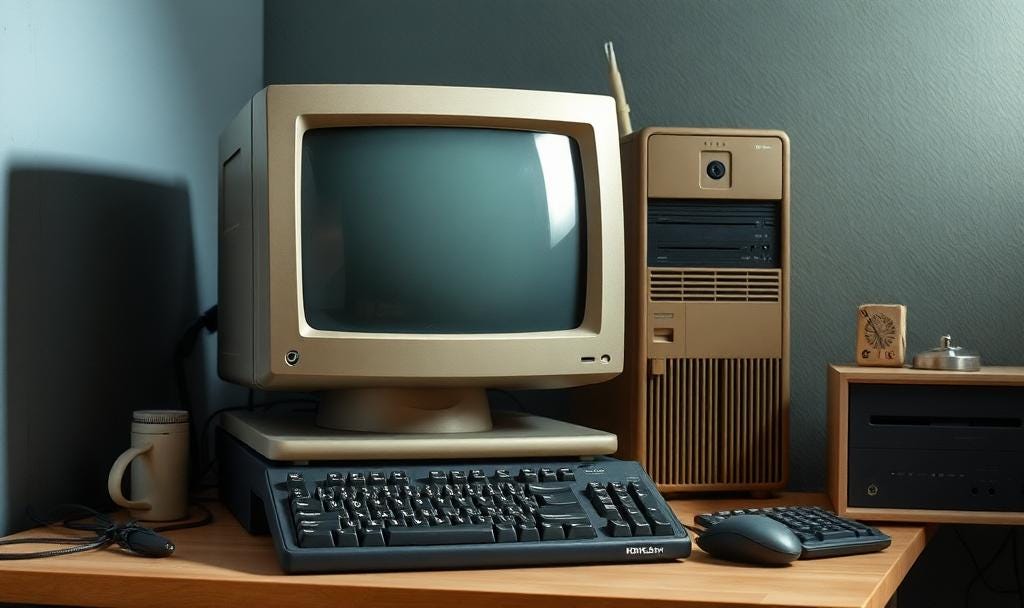
Personal computers were already ubiquitous by the time I was forming my earliest memories in the mid-nineties. Granted, most of them were the fat desktop computers with the bulky towers that sounded like an airport landing strip when they booted up. And the housephone wouldn’t work when you were on the internet because, you know, dial-up. And it took a minute and a half to load a single page, and twice that to load a video. These weren’t the high-powered machines we have today, but they were bona fide web-accessing devices, and they thoroughly shaped my upbringing.
I typed my essays on a PC rather than a typewriter, but I never had a robot write for me.
At this pivotal moment in technological history, authors are asking themselves questions they’ve never had to ask before. Does artificial intelligence write well? If I give AI an outline and some context, can it write me an article? A book? If ChatGPT writes something for me, but I gave it the unformed information to write about, does the final product count as mine? When I collaborate with AI in my writing, what’s ethical and what’s not? What’s going to yield good results, and what won’t?
AI today is like desktop computers were when I was a kid in the nineties. It’s everywhere, but it’s clunky and prototypical. Sure, there are people who really know how to use AI (usually the paid version with all the bells and whistles)—these folks can do sophisticated things with artificial intelligence that make our collective jaw drop. But for most of us using the free app on our cell phones, ChatGPT is just an upgraded version of Google; it’s a search engine with a conversational feel.
When it comes to writing, AI is still the fat desktop with the bulky tower on dial-up internet. I’ve seen full book manuscripts written by AI, and you can tell a robot wrote them. The logic is circular, the language gets repetitive, they rely on trite catchphrases like “Let’s do a deep dive,” and unintentional plagiarism is an ever-present danger. AI’s writing quality is certainly going to improve as the tech advances, much like those big ugly desktops have evolved into the sleek, efficient laptops of today. But for now, artificial intelligence is pretty elementary as a writer.
Using AI in your writing also brings up several ethical concerns. Publishers and media outlets are making tough decisions about what type of AI usage they’ll permit writers to engage in. Courts are issuing AI-related rulings on copyright and fair use. Writers have to choose whether using AI is ethical, and if they use it they need to decide whether to disclose that use to readers.
Despite the substandard writing quality and the ethical risks, writers must learn how to coexist with AI. It’s here to stay, and it’s only going to become more advanced and more prevalent. We could all be purists and avoid artificial intelligence like the plague, but the writing and publishing universe will chug along without us, and we’d become obsolete. By the time AI evolves beyond its current prototype phase, we won’t have the knowledge and skills we need for the new age of authorship. Instead, we can learn how to be effective, ethical writers in the AI era. That may mean using AI in our own writing, or it may simply mean understanding the rules and best practices of AI-related writing so that we’re not left behind.
If you’re going to integrate AI into your writing, here are two thoughts to help guide you:
1. Before you use AI in your writing at all, be ABSOLUTELY CERTAIN you’re allowed to use it.
If you’re writing for a grade, no AI use. Period. Not to make you an outline, not to jumpstart your research, not to rephrase a sentence—nothing. Academia is one area I’m still a bit of a purist, and that’s because of the risk of plagiarism. Unless your professor specifically tells you that you can use AI for a given project, don’t do it.
Aside from graded writing, the most important thing is to determine who you’re writing for and follow their rules. Are you writing a book and aiming to be traditionally published? Look at a few of the publishing houses you’d like to pursue and find out their stance on AI. Are you pitching an article to a magazine editor? Ask whether they allow AI collaboration and if there are any limits to what you can use AI for. Are you writing for yourself on a platform like Substack? You make the rules—research the latest guidance on ethical use of AI, figure out what feels right to you, decide what would best serve your audience, and go for it.
2. AI needs a human editor.
Let’s say you’ve decided to commission AI to write a short piece for you. You’re going to give it a topic, have a Q&A session with it, and watch it spit out some words. The piece you’ll get back will most likely have virtually no grammatical errors, and it will look neat and tidy. But look closer!
The piece will also probably sound like a robot wrote it. It will have redundancies, gaps in logic, abundant catchphrases, and other issues. You will need to make it sound human.
If you’re commissioning AI to write for you, you’ll need to take a thorough look at what it has written and edit it. You’d be wise to hire a professional editor to help you. AI can save you some effort by producing decent raw materials to work with, but a human being has to shape those raw materials into something worth reading.
And even though it doesn’t mean to, it often quotes without citing, doesn’t properly attribute facts and figures to the sources they came from, and uses disreputable sources to get that info in the first place. You’ll need to check for plagiarism, cite where necessary, and switch out bad data for good data.
I must have stored up lots of bad karma for ribbing my mom, because my kids now look at me like I’m a dinosaur. They think of housephones, VHS tapes, and MapQuest as prehistoric technology. They cannot imagine a world without smartphones in every adult’s pocket, every song, movie, and piece of information available in a few clicks. And pretty soon, AI will be so integrated into our daily existence that my children won’t remember life without it. I want to be a writer who flows with technological developments like AI, staying relevant but remaining true to the art of writing. How about you?
[If you used ChatGPT to write your manuscript, my team can make it sound human (and guide you on ethical use of AI in writing). Visit www.vandunkedits.com to book a free consultation.]
I disagree with how swiftly you caved to AI taking over writing. You also make it sound like people are writing a piece of literature when they prompt AI to write, then edit it. That’s the same as calling someone an artist if they prompt AI for an image, then tweak a few things. That’s not a writer, and that’s not an artist. To write is to think, if you are not thinking, then you’re not writing. AI will give you answers but it cannot articulate thought for you.
For people who use AI to write, I think your two suggestions are valid.